

The Weight-Bearing Plantar Flexion Test assesses ankle plantar flexion in a functional loaded position, commonly through a heel-rise style movement. Direct evidence for the exact MAT Weight-Bearing Plantar Flexion Test is limited, but closely related research supports the Functional Heel-Rise Test a...

The MAT Hip Internal Rotation Test assesses hip internal rotation range of motion. Hip internal rotation can be measured in different positions, including sitting, prone or supine with hip flexion, and results can vary depending on setup. Research supports the reliability of digital inclinometers an...
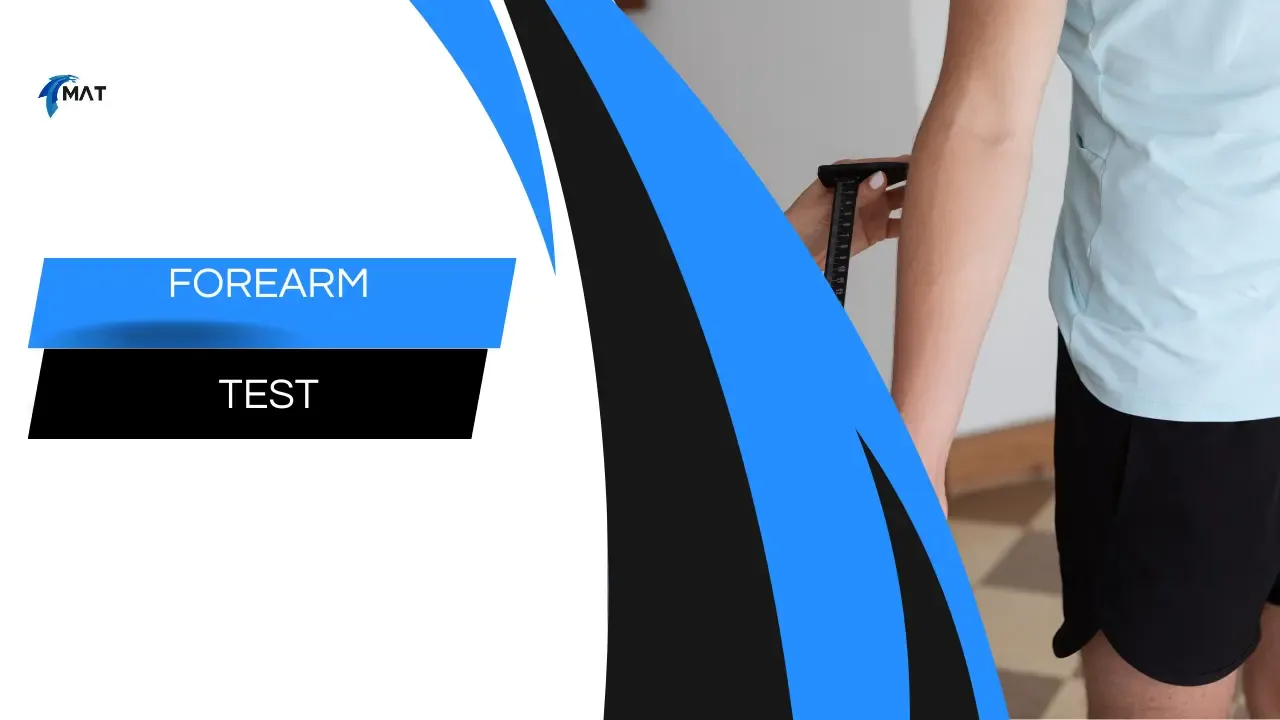
To measure forearm girth, follow these steps:
1. Use a flexible tape measure or a piece of string that can be measured afterward.
2. Stand with your arm extended in front of you and your palm facing up.
3. Locate the bony prominence on the side of your elbow, called the lateral epicondyle.
4. Place th...
The Upper Quarter Y-Balance Test, often abbreviated as UQYBT or YBT-UQ, is a closed-chain upper-limb reach test performed from a push-up or modified push-up position. It measures how far the free hand can reach in the medial, superolateral and inferolateral directions while the opposite arm supports...
Short Article Summary
The Star Excursion Sitting Test adapts star-style reach testing into a seated position. Exact peer-reviewed evidence for this specific MAT test is limited, so interpretation should be based on standardised setup, baseline comparison and related evidence from dynamic reaching a...
The Single-Leg Balance Eyes Closed Test measures how long a client can stand on one leg without visual input. It is more demanding than the eyes-open version and is closely related to the Unipedal Stance Test, which has published normative values for eyes-open and eyes-closed conditions.
Introduc...
The Single-Leg Balance Eyes Open Test measures how long a client can stand on one leg while keeping their eyes open. It is closely related to the Unipedal Stance Test, which has published normative values for eyes-open and eyes-closed conditions across age groups and sex.
Introduction
Single-leg...
The Lower Quarter Y Balance Test, or YBT-LQ, is a simplified and standardised version of the Star Excursion Balance Test using three reach directions: anterior, posteromedial and posterolateral. A systematic review and meta-analysis found the YBT-LQ has evidence for reliability, discriminant validit...
The Star Excursion Balance Test, or SEBT, is a dynamic balance test where the client stands on one leg and reaches as far as possible in multiple directions with the opposite leg. It is recognised as a test of dynamic postural control that challenges strength, range of motion, neuromuscular control ...
To measure a client's arm length from C7 SP to 3rd digit, follow these steps:
1. Ask the client to remove any bulky clothing and to stand up straight with their back against a wall.
2. Locate the seventh cervical vertebra (C7), which is the bony prominence at the base of the neck.
3. Use a measuring ...
To measure a client's leg length from ASIS to medial malleolus, follow these steps:
1. Ask the client to remove their shoes and any bulky clothing.
2. Ask the client to lie down on their back on a flat surface, such as an examination table.
3. Locate the anterior superior iliac spine (ASIS), which is...

To measure a client's ankle girth, follow these steps:
1. Ask the client to remove any bulky clothing and to sit on a chair with their feet flat on the ground.
2. Locate the bony prominence on the inside of the client's ankle, called the medial malleolus.
3. Place the tape measure or string just abov...


