
The Grip Strength Straight Arm Pronated Test measures how much grip force a client can produce while the elbow is extended and the forearm is turned palm-down. It is a practical variation of maximal handgrip testing that may be useful when a professional wants to assess grip force in a more extended...
The Grip Strength Straight Arm Neutral Test measures how much grip force a client can produce while the elbow is extended and the forearm is held in a neutral position, usually with the thumb facing upward. It is a practical variation of maximal handgrip testing that may be useful when a professiona...
The Grip Strength Straight Arm Supinated Test measures how much grip force a client can produce while the elbow is extended and the forearm is turned palm-up. It is a practical variation of maximal handgrip testing that may be useful when a professional wants to assess grip force in a more extended-...
The Grip Strength Bent Arm Pronated Test measures how much grip force a client can produce while the elbow is bent and the forearm is turned palm-down. It is a practical variation of maximal handgrip testing that may be useful when a professional wants to assess grip force in a position that resembl...
The Grip Strength Bent Arm Neutral Test measures how much grip force a client can produce while the elbow is bent and the forearm is held in a neutral position, usually with the thumb facing upward. This position is closely aligned with many standard handgrip dynamometry protocols and is one of the ...
The Grip Strength Bent Arm Supinated Test measures how much grip force a client can produce while the elbow is bent and the forearm is turned palm-up. It is a practical variation of maximal handgrip testing that may be useful when a professional wants to assess grip force in a position that resemble...
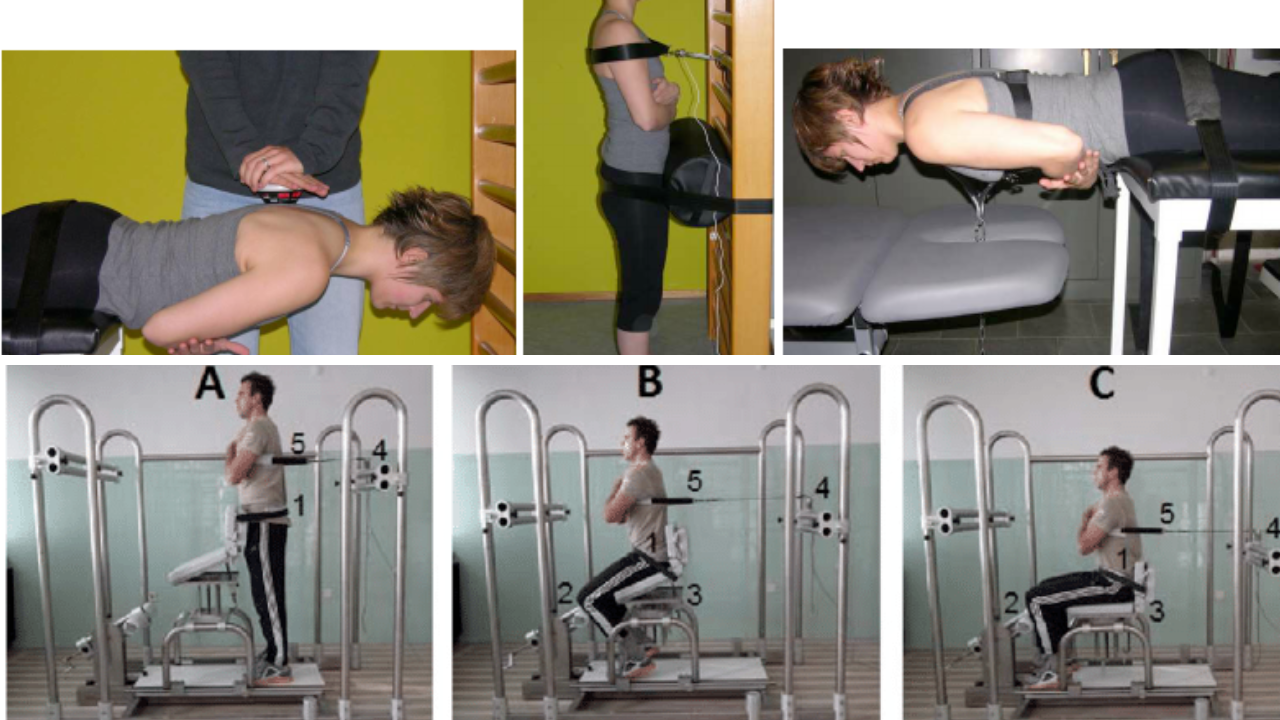
The Spinal Extension Strength Test measures how much force a client can produce when extending the trunk backward against a Muscle Meter, handheld dynamometer or fixed resistance setup.
This test can be performed using either:
- The pusher cap, where the client pushes backward directly into the Mu...
Fatigue Index describes how much performance declines across repeated efforts or across a sustained high-intensity test. It is commonly used in repeated sprint tests, Wingate-style anaerobic testing, repeated strength tests, isokinetic endurance testing, repeated jumps, force testing and sport-perfo...
Time to Peak measures how long it takes a client to reach the highest value in a test. Depending on the assessment, this may refer to time to peak force, time to peak torque, time to peak power, time to peak velocity or another peak output.
In force and torque testing, Time to Peak helps profession...
Rate of Force Development, commonly abbreviated as RFD, measures how quickly force is produced. It is one of the most useful force-time metrics when a professional wants to understand not only how much force a client can produce, but how fast they can produce it.
Peak force tells you the highest fo...
Rate of Torque Development, commonly abbreviated as RTD, measures how quickly torque is produced around a joint. In simple terms, it shows how fast a client can generate joint-specific rotational force.
Torque tells you how much rotational force a client can produce. RTD tells you how quickly they ...
Torque measures the rotational effect of force around a joint or axis. In strength testing, it helps describe how much turning force a client can produce around a joint, such as the knee, hip, ankle, shoulder or elbow.
Torque is commonly used in isometric testing, isokinetic dynamometry, handheld d...


