
Spinal Extension Strength Test
Jun 05, 2026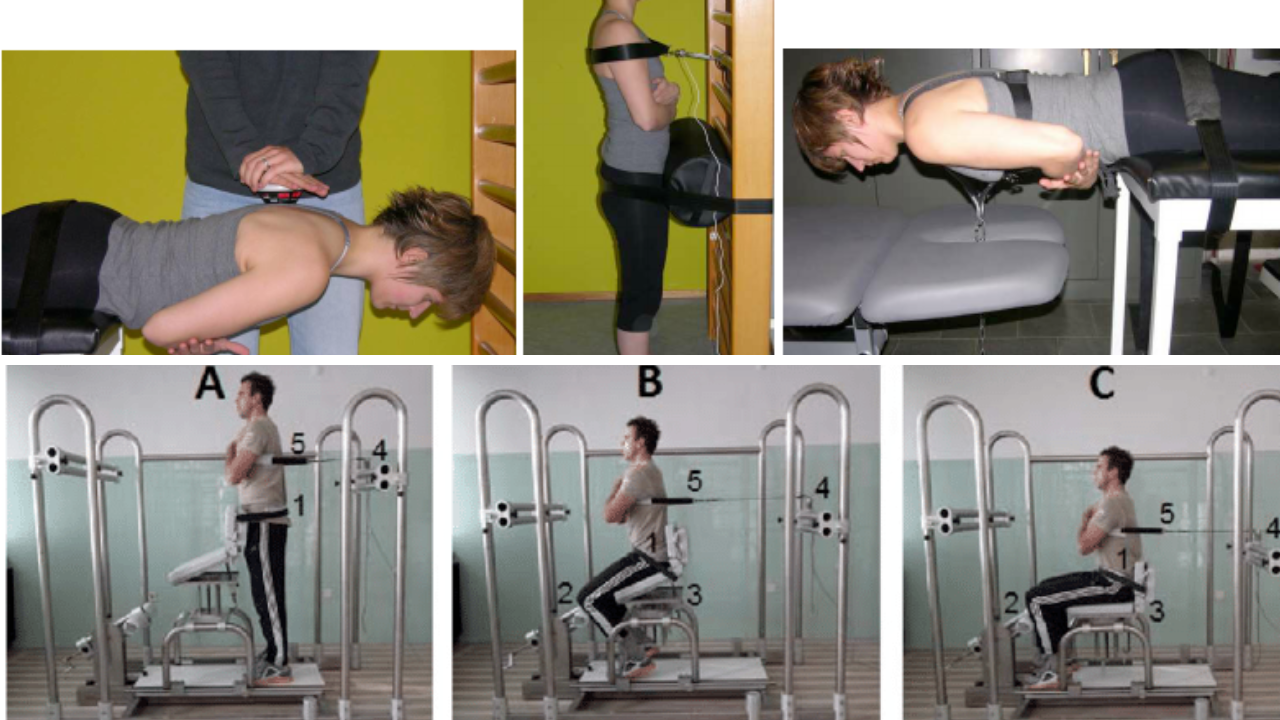
The Spinal Extension Strength Test measures how much force a client can produce when extending the trunk backward against a Muscle Meter, handheld dynamometer or fixed resistance setup.
This test can be performed using either:
- The pusher cap, where the client pushes backward directly into the Muscle Meter
- The puller straps, where the client pushes or pulls backward against a strap system with the Muscle Meter in-line
Trunk extension strength may be relevant for lifting, hinging, carrying, bracing, sport, occupational tasks, posture control, posterior-chain capacity and general physical performance.
The result should not be used alone to diagnose back pain, spinal pathology, tissue injury or readiness for sport or work. It should be interpreted alongside symptoms, confidence, range of motion, movement quality, hip strength, work or sport demands, training history and related assessment findings.
What Is the Spinal Extension Strength Test?
The Spinal Extension Strength Test is an isometric trunk strength assessment.
The client attempts to extend the trunk backward while the Muscle Meter or strap setup resists movement. The aim is to measure force output without allowing the trunk to move through range.
The test does not measure spinal mobility, pain cause, spinal stability, lifting technique, endurance or functional capacity on its own.
It is most useful when the same setup is repeated over time so results can be compared with the client’s own baseline.
What Is the Muscle Meter?
The Muscle Meter is a handheld dynamometry tool used to measure force output during push, pull and isometric strength assessments.
When used on its own, the Muscle Meter primarily measures peak force, which is the highest force value produced during the test.
When used with Measurz, Muscle Meter data can be recorded and analysed with a broader set of strength and force-time metrics, including:
- Peak force
- Impulse
- Torque
- Rate of torque development
- Rate of force development
- Time to peak
- Fatigue index
For routine spinal extension testing, peak force is usually the main metric.
Other metrics may be useful when the setup supports them:
- Torque may be useful if the lever arm from the trunk axis to the force application point is measured.
- Rate of force development may be useful for athletes, manual workers or clients who need rapid trunk extension force.
- Time to peak may help show whether force is produced quickly or slowly.
- Impulse may be useful if sustained trunk extension force over a defined time window is relevant.
- Fatigue index is only relevant if repeated or sustained contractions are tested.
Not every test needs every metric. The metric should match the assessment question.
Recommended Standard Setup
For consistency and safety, the preferred standard protocol is a seated isometric trunk extension test.
Client position
- Client seated upright on a stable bench, chair or plinth
- Feet flat on the floor
- Hips flexed to approximately 90 degrees
- Knees flexed to approximately 90 degrees
- Pelvis neutral
- Trunk upright
- Arms crossed over chest or placed in a standardised position
- Head and neck neutral
- Feet, pelvis and thighs stabilised where possible
Why seated?
A seated position helps reduce lower-limb contribution and makes it easier to standardise:
- Pelvis position
- Trunk angle
- Foot position
- Hip and knee angle
- Device placement
- Retesting conditions
A standing version may be used for sport or workplace specificity, but seated testing is usually easier to repeat.
Option 1: Spinal Extension Test With Pusher Cap
The pusher cap protocol is used when the client pushes backward directly into the Muscle Meter while the professional or an external setup stabilises the device.
This option is simple and fast. However, it relies more on the professional’s ability to resist force. For stronger clients, a fixed setup or puller strap protocol may provide better repeatability.
Step-by-Step Protocol / Practice
1. Prepare the client
Explain the test:
“We are going to measure how much force you can produce when pushing your trunk backward into the Muscle Meter. Build your effort gradually, push as hard as you safely can, and tell me if you feel pain or unusual symptoms.”
Record current symptoms, confidence, recent flare-ups, fatigue and any movements that should be avoided.
2. Set the client position
- Client seated upright
- Feet flat
- Hips and knees around 90 degrees
- Pelvis stabilised
- Arms crossed or standardised
- Trunk neutral before testing
3. Place the device
Place the pusher cap against the upper thoracic spine, mid-thoracic region or upper back, depending on client comfort and the chosen protocol.
Avoid placing direct pressure over painful bony areas.
Record the exact contact point so the same position can be repeated.
4. Stabilise the position
Stabilise the client so that force comes mainly from trunk extension.
Control:
- Pelvis movement
- Hip extension strategy
- Feet pushing excessively into the floor
- Shoulder retraction dominance
- Lumbar over-arching
- Trunk rotation
The aim is to assess trunk extension force, not hip drive or shoulder movement.
5. Give clear instructions
Use consistent cueing:
“Push your upper back backward into the Muscle Meter. Build up gradually. Push as hard as you safely can. Hold. Keep breathing. Keep your pelvis still.”
6. Record trials
Use:
- 1–2 submaximal practice trials
- 2–3 recorded maximal trials
- 3–5 second contraction
- 45–90 seconds rest between trials
- Same scoring method each time: best score or average score
7. Identify invalid trials
Repeat or mark invalid if:
- Pelvis shifts
- Feet push excessively
- Client arches through the hips rather than the trunk
- Device slips
- Client rotates
- Pain unexpectedly limits effort
- Professional cannot stabilise the device
Option 2: Spinal Extension Test With Puller Straps
The puller strap protocol uses the Muscle Meter with straps, handles or a fixed anchor point to measure force while the client pushes or pulls into trunk extension.
This setup may be more repeatable for stronger clients because it reduces the influence of the professional’s ability to manually resist force.
Step-by-Step Protocol / Practice
1. Prepare the client
Explain the test:
“We are going to measure how much force you can produce when pushing your trunk backward against the strap setup. Build your effort gradually and tell me if you feel pain or unusual symptoms.”
2. Set the client position
- Client seated upright
- Feet flat
- Hips and knees around 90 degrees
- Pelvis stabilised
- Trunk neutral
- Strap positioned across the upper back or thoracic region
- Muscle Meter connected in-line with the strap and anchor point
3. Place the strap
Place the strap across the upper thoracic region or mid-thoracic region, depending on protocol.
Avoid pressure over painful spinal areas.
Record:
- Strap height
- Contact region
- Anchor height
- Anchor distance
- Client distance from anchor
- Muscle Meter orientation
4. Stabilise the position
Stabilise:
- Pelvis
- Thighs
- Feet
- Trunk start position
Prevent:
- Hip extension strategy
- Pelvis sliding
- Shoulder retraction dominance
- Lumbar over-arching
- Trunk rotation
- Anchor movement
5. Give clear instructions
Use consistent cueing:
“Push your trunk backward into the strap. Build up gradually. Push as hard as you safely can. Hold. Keep breathing. Keep your pelvis still.”
6. Record trials
Use:
- 1–2 submaximal practice trials
- 2–3 recorded maximal trials
- 3–5 second contraction
- 45–90 seconds rest
- Best or average score recorded consistently
7. Identify invalid trials
Repeat or mark invalid if:
- Strap slips
- Pelvis moves
- Feet push excessively
- Client rotates
- Lumbar extension dominates
- Anchor point shifts
- Muscle Meter angle changes
- Pain unexpectedly limits effort
Scoring
The primary score is usually peak force.
Record whether the final value is:
- Best trial
- Average of trials
- Peak force
- Force normalised to body mass, if used
- Torque, if lever arm is measured
Use the same scoring method at retest.
Do not compare:
- Pusher cap values with puller strap values as if they are the same test
- Seated values with standing values as if they are the same test
- Results from different anchor heights, strap positions or device placements
Understanding the Result
A higher score may suggest greater trunk extension force output in that specific test setup.
A lower score may suggest reduced trunk extension force output, but the reason should be interpreted carefully.
Possible influences include:
- Pain
- Apprehension
- Poor familiarisation
- Fatigue
- Guarding
- Poor stabilisation
- Pelvis movement
- Hip compensation
- Different device placement
- Different strap angle
- Different trunk position
- Breath holding
- Client confidence
The result becomes more useful when compared with:
- The client’s own baseline
- Repeated measurements over time
- Flexion strength using the same setup
- Symptoms
- Confidence
- Range of motion
- Hip extension strength
- Lifting or sport demands
- Work demands
- Related trunk and lower-limb strength tests
- Functional or performance tasks
A single score should not be used alone to explain pain, determine capacity or clear participation.
Published Reference Values, Norms and Comparative Data
Published reference values for the exact Muscle Meter spinal extension pusher-cap or puller-strap protocol are currently limited. The best available data should be used as comparison context, not direct Muscle Meter norms.
The easiest way to understand trunk strength data is to look at torque relative to body mass, usually reported as N·m/kg. This adjusts strength for body size and can be easier to compare between clients.
In healthy adults aged 18–30 years, ÜNver et al. (2024) reported the following approximate trunk extension values using an isokinetic dynamometer:
- Men: trunk extension was approximately 2.0 N·m/kg
- Women: trunk extension was approximately 1.1 N·m/kg
- Combined group: trunk extension was approximately 1.5 N·m/kg
These values were collected with a different device and protocol, so they should not be treated as exact Muscle Meter targets. They are useful as broad context for understanding trunk extension strength in healthy young adults.
For Muscle Meter testing, the best comparison is usually:
- The client’s own baseline
- Their repeated results over time
- Extension compared with flexion using the same setup
- Symptoms during testing
- Confidence and effort quality
- Work, sport or training demands
Use published values as educational context, not as a pass/fail standard.
Assessing and Providing Context for Different Client Populations
Youth clients
In youth clients, trunk extension strength may be influenced by growth, maturation, coordination, attention, training age and confidence with maximal effort testing.
Use the test mainly for baseline comparison, progress tracking and sport or movement education.
Avoid comparing youth clients directly with adult reference values unless the research population matches their age and maturation stage.
Adults and general fitness clients
For general fitness clients, this test is often most useful for showing whether trunk extension force output is changing over time.
Use the result to provide context around baseline strength, confidence with trunk loading, symptoms during resisted trunk effort and functional goals such as lifting, carrying, hinging or gym-based exercise.
Older adults
In older adults, trunk extension strength may be relevant to standing tolerance, lifting, carrying, transfers, walking confidence and daily tasks.
Use clear instructions, allow practice trials, monitor fatigue and consider longer rest periods. Interpret the result alongside balance, gait, sit-to-stand ability, hip strength, confidence and daily function.
Athletes and sport clients
For athletes, trunk extension strength may provide useful context for bracing, sprinting, jumping, grappling, contact demands, throwing, kicking, hinging or lifting.
Peak trunk extension force alone does not equal performance. Interpret results with rate of force development, trunk rotation strength, hip extension strength, posterior-chain capacity, sport skill, fatigue resistance and role demands.
Workplace and manual task clients
For workplace or occupational settings, trunk extension strength may provide context for lifting, carrying, bracing, pushing, pulling, prolonged standing and repeated manual tasks.
Do not use one trunk extension score to clear someone for full work duties. Interpret with job demands, symptoms, fatigue, ergonomics, confidence and task-specific tolerance.
Clients returning after injury
For clients returning after back, hip, pelvic or lower-limb injury, trunk extension strength testing may help monitor force output, confidence and symptom response.
A stronger score does not confirm readiness. A lower score does not explain the cause of symptoms.
Clients with pain or persistent symptoms
Pain, fear of movement, guarding, fatigue, apprehension and low confidence can all reduce trunk extension force output.
Start with lower intensity if needed, record symptoms before and after, and avoid maximal testing if symptoms are highly irritable.
Higher body mass clients
In higher body mass clients, absolute force may be high, but force relative to body mass may provide different context.
Avoid assuming that higher body mass automatically means poor trunk capacity. Interpretation should be linked to the client’s goals and tasks.
Reliability and Measurement Considerations
Handheld dynamometry can be reliable for trunk extension testing when the setup is controlled. Althobaiti and Falla (2023) reported that handheld dynamometry demonstrated acceptable reliability and criterion validity for measuring trunk muscle strength in people with and without chronic non-specific low back pain. De Blaiser et al. (2018) also reported that handheld dynamometry could be reliable and valid for measuring trunk flexor and extensor strength in a healthy athletic population.
To improve reliability:
- Use the same test position each time.
- Use the same device attachment each time.
- Standardise pusher cap or strap placement.
- Standardise anchor height and distance if using straps.
- Stabilise the pelvis and lower body.
- Use consistent instructions.
- Use the same contraction duration.
- Use the same rest period.
- Record symptoms and compensations.
- Avoid comparing different protocols directly.
A change is more meaningful when it is repeated across sessions, aligns with improved symptoms, confidence or function, and is supported by related assessment findings.
Common Errors and Limitations
Common errors include:
- Poor pelvis stabilisation
- Hip movement replacing trunk extension
- Shoulder retraction dominating the test
- Lumbar over-arching
- Trunk rotation during testing
- Inconsistent device placement
- Inconsistent strap angle
- Anchor point movement
- Excessive floor pushing
- Breath holding
- Testing through high pain
- Comparing pusher cap and strap results directly
- Treating the score as a diagnosis
Limitations include:
- Trunk extension testing is highly setup-dependent.
- Manual resistance may be limited by the professional’s strength.
- Strap setup requires careful anchor control.
- Pain, fear or guarding can reduce force output.
- Peak force does not measure endurance or movement quality.
- Published norms are not universal across protocols.
Practical Applications
This protocol may be useful for:
- Baseline trunk extension strength assessment
- Monitoring progress over time
- Comparing trunk extension and flexion capacity
- Strength profiling for sport or occupational demands
- Tracking change during training or intervention blocks
- Client education
- Identifying whether force output changes alongside symptoms or function
It may be especially useful when combined with spine range of motion, hip extension strength testing, functional lifting tasks, pain monitoring and work or sport-specific capacity assessments.
Ideas to Make the Result Better
If trunk extension force is low
Consider assessing general trunk strength, hip extension strength, posterior-chain capacity, confidence with trunk loading, pain response, breathing and bracing strategy, and functional lifting or carrying tolerance.
If extension is much lower than flexion
Consider comparing with hip extension strength, posterior-chain capacity, back extension tolerance, standing posture tolerance, lifting, hinging or carrying tasks.
Do not assume the score reflects spinal pathology.
If pain limits the result
Consider reducing intensity, using submaximal monitoring, recording pain response clearly, testing a less provocative position and referring on if symptoms fall outside professional scope.
If force is good but function is limited
Consider whether the limiting factor is endurance, coordination, movement confidence, range of motion, hip strength, technique, fatigue response or sport/work-specific task tolerance.
If the client is improving
Useful signs may include higher peak force, lower pain at the same force output, better confidence, fewer compensations and improved functional or work-task tolerance.
Safety Considerations
Avoid maximal testing or modify the protocol if the client reports:
- Severe or worsening back pain
- Sharp pain during setup
- Neurological symptoms
- Dizziness
- Recent spinal surgery
- Recent trauma
- Unexplained symptoms
- Symptoms outside your professional scope
Stop testing if symptoms become sharp, worsening, unusual or unsafe.
Recommended Standard Protocol Summary
For most professional settings, use this as the default:
- Position: seated
- Trunk start position: neutral
- Hip and knee angle: approximately 90 degrees
- Trials: 2–3 recorded trials
- Contraction duration: 3–5 seconds
- Rest: 45–90 seconds
- Metric: peak force
- Attachment: pusher cap or puller straps, recorded clearly
- Final score: best trial or average trial, used consistently
- Key requirement: same setup at retest
FAQs
What does this test measure?
It measures isometric trunk extension force in a specific testing setup.
What does the Muscle Meter measure by itself?
When used on its own, the Muscle Meter primarily measures peak force.
Can this test diagnose back pain?
No. It may provide useful information about force output, but it does not diagnose the cause of pain.
Should I use the pusher cap or puller straps?
Use the pusher cap for a quick, simple setup. Use puller straps when you want stronger fixation or when testing stronger clients.
Can I compare pusher cap and puller strap results?
Not directly. They should be treated as different protocols unless the setup has been validated for comparison.
Are there Muscle Meter-specific norms?
Published direct Muscle Meter norms for this exact protocol are limited. Use the client’s baseline first, and use published trunk dynamometry data as broader comparison context.
What is the main metric?
Peak force is usually the main metric. Torque may be useful if lever arm is measured.
Key Takeaways
- The Muscle Meter can be used to assess spinal extension strength with either the pusher cap or puller straps.
- The pusher cap is simple and practical, but may be limited by the professional’s ability to resist force.
- Puller straps may improve consistency for stronger clients when the anchor setup is stable.
- Peak force is usually the main metric.
- Strap-based and pusher-cap results should be recorded as separate protocols.
- Published trunk extension values are useful as comparison data, not direct Muscle Meter norms.
- Results are most useful when compared with the client’s own baseline and repeated over time.
- The test should support assessment reasoning, not diagnosis or clearance decisions.
References
Althobaiti, S., & Falla, D. (2023). Reliability and criterion validity of handheld dynamometry for measuring trunk muscle strength in people with and without chronic non-specific low back pain. Musculoskeletal Science and Practice, 66, Article 102799. https://doi.org/10.1016/j.msksp.2023.102799
De Blaiser, C., De Ridder, R., Willems, T., Danneels, L., & Roosen, P. (2018). Reliability and validity of trunk flexor and trunk extensor strength measurements using handheld dynamometry in a healthy athletic population. Physical Therapy in Sport, 34, 180–186. https://doi.org/10.1016/j.ptsp.2018.10.005
ÜNver, F., Gur Kabul, E., Buke, M., & ÜNver, B. (2024). Trunk flexor and extensor muscle strength capacity in healthy individuals. Turkish Journal of Sports Medicine, 59(3), 112–118. https://doi.org/10.47447/tjsm.0827
Download Our Measurz App For FREE And Perform, Record and Track 800+ Tests With Your Clients Today.
Want To Improve Your Assessment?
Not Sure If The MAT Data-Driven Approach Is Right For You?
Get a taste of our MAT Course and data-driven approach using the MAT with a FREE module from our online MAT Course.
We hate SPAM. We will never sell your information, for any reason.


