
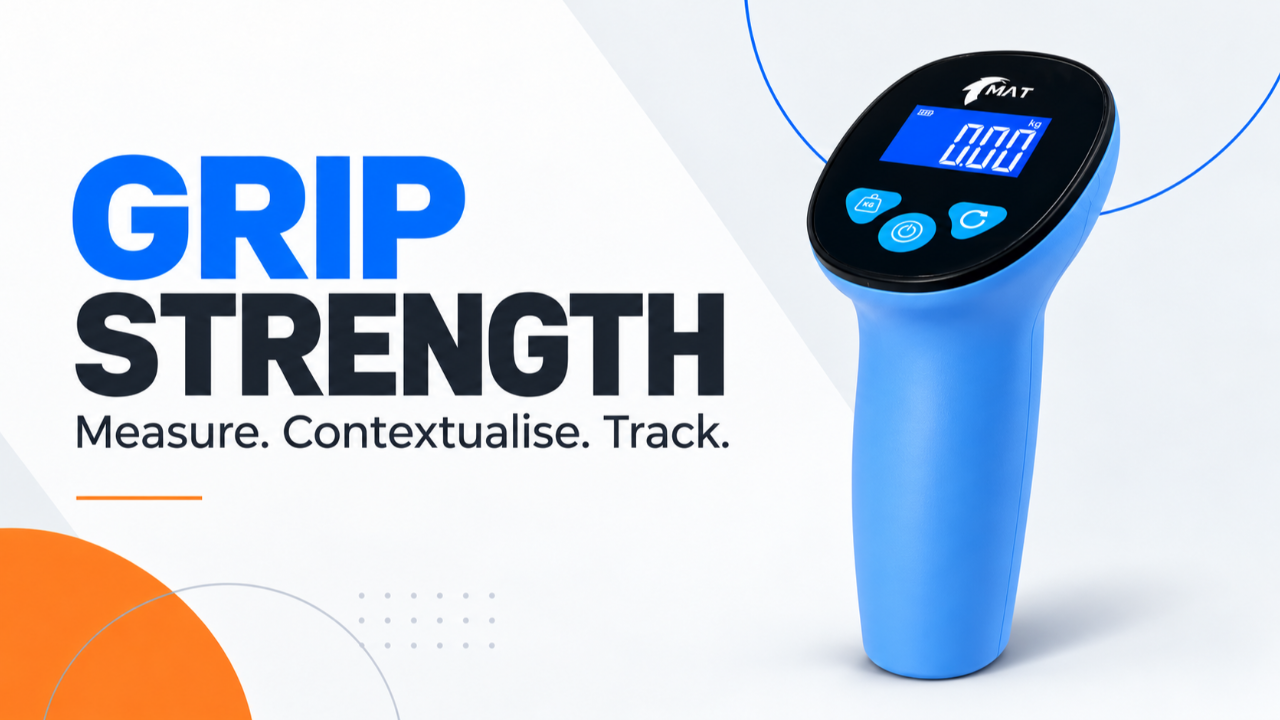
Grip strength is a simple, practical way to measure hand strength and build an objective picture of physical capacity. Comparing results with appropriate population reference values and tracking them over time makes the assessment more useful for everyday activity, work and performance.
Relative gr...
The MAT Spinal Assessment provides a standardised method of assessing spinal flexibility in standing across all three anatomical planes of movement. It enables clinicians and exercise professionals to objectively measure spinal mobility, identify movement limitations, and monitor changes over time....
Pain can affect more than intensity. It may influence movement, mood, walking, work, sleep, relationships, enjoyment of life, training and confidence.
The Brief Pain Inventory was originally developed for cancer pain assessment and has since been used widely across many pain populations, including ...
The step version of the single-leg calf raise can be useful when the professional wants to assess calf endurance through a larger ankle range of motion than the ground version. Because the heel can lower below forefoot level, the test may increase the ROM demand on the calf-Achilles complex.
This m...
Calf endurance is important for walking, running, hopping, jumping, change of direction, stair climbing and many field- and court-based sports. The single-leg calf raise is one of the most common practical tests for assessing plantar-flexor endurance because it requires minimal equipment and can be ...
Shoulder external rotation endurance can be relevant for overhead sport, throwing, swimming, racquet sports, gym training and work tasks that require repeated or sustained shoulder control.
Unlike repetition-based external rotation tests, the hold version assesses how long the client can maintain a...
Sustained shoulder flexion endurance can be relevant for overhead sport, gym training, work tasks, carrying tasks, reaching and repeated arm elevation. Holding the arm in a flexed position under load provides a different endurance challenge to repetition-based testing.
The 5% bodyweight version is ...
Shoulder external rotation endurance can be relevant for overhead sport, throwing, racquet sports, swimming, gym training and work tasks involving repeated arm use. External rotation endurance may also provide useful context when assessing shoulder control, fatigue response and side-to-side differen...
Shoulder endurance is important in overhead sport, gym training, work tasks and athletic positions requiring repeated arm elevation. While maximal strength tests show peak force capacity, repetition-based endurance tests provide additional information about fatigue tolerance and repeatability under ...
Push-up endurance can be relevant for gym training, field sports, combat sports, military-style fitness testing, general fitness, upper-body conditioning and return-to-training progress monitoring.
The Push Up Test provides a simple way to assess repeated upper-body pushing performance without spec...
The hip bridge is a simple and practical field assessment that can be used to monitor hip extension endurance, posterior-chain endurance and pelvic control. It is commonly used in fitness, sport, rehabilitation-adjacent exercise settings and performance monitoring because it is easy to set up, requi...
Hamstring and posterior-chain endurance can be relevant for running, sprinting, jumping, field sports, gym training and lower-limb performance. The Hamstring Bridge Endurance Test provides a practical way to assess how well a client can maintain or repeatedly perform a bridge position with increased...


