
A client may report difficulty bending the knee fully, reduced comfort when kneeling, stiffness during squatting, or a side-to-side difference after a period of reduced loading, symptoms or training interruption.
The Supine Heel to Butt Test gives a simple way to assess knee flexion using a practic...
A client may report difficulty reaching overhead, reduced streamline position in swimming, stiffness during overhead lifting, discomfort with shoulder flexion, or a feeling that both shoulders do not move evenly.
The Combined Elevation Test gives a simple way to assess overhead movement as an integ...
A client may report difficulty reaching overhead, reduced comfort in swimming streamline positions, asymmetry during throwing, discomfort in overhead lifting, or a side-to-side difference after a period of reduced loading, pain or training interruption.
The Single Arm Combined Elevation Test gives ...
A client may report difficulty moving the jaw forward, jaw stiffness, clicking, discomfort chewing, symptoms with biting, or a feeling that the jaw does not move evenly.
The TMJ Translation Test gives a simple way to quantify forward jaw movement. It does not explain the cause of reduced translatio...
A client may report difficulty opening the mouth, jaw stiffness, clicking, discomfort chewing, symptoms with yawning, or a change in jaw movement after a flare-up or period of guarding.
The TMJ Depression Test gives a simple way to quantify jaw opening. It does not explain the cause of reduced open...
A client may report headache symptoms, upper neck stiffness, reduced ability to rotate the head, or a clear side-to-side difference when turning the head. Another client may show limited upper cervical movement after a period of neck symptoms, guarding or reduced activity.
The Neck Flexion Rotation...
A client may report difficulty squatting, sitting comfortably, rotating through the hip, changing direction, or moving into sport-specific positions. Another client may show a clear difference between left and right hip rotation after a period of pain, reduced loading or training interruption.
The ...
A client may report difficulty sitting cross-legged, limited hip rotation during squatting, discomfort changing direction, or asymmetry during sport, gym or daily tasks.
The Seated Hip External Rotation Test gives a simple way to quantify hip outward rotation in degrees. It does not explain the cau...

Ankle dorsiflexion is a foundational component of lower-limb movement. Adequate motion at the ankle is required for squatting, running, jumping, and efficient change of direction. When dorsiflexion is limited, compensatory strategies often emerge at the knee, hip, or foot.
To interpret ankle mobili...
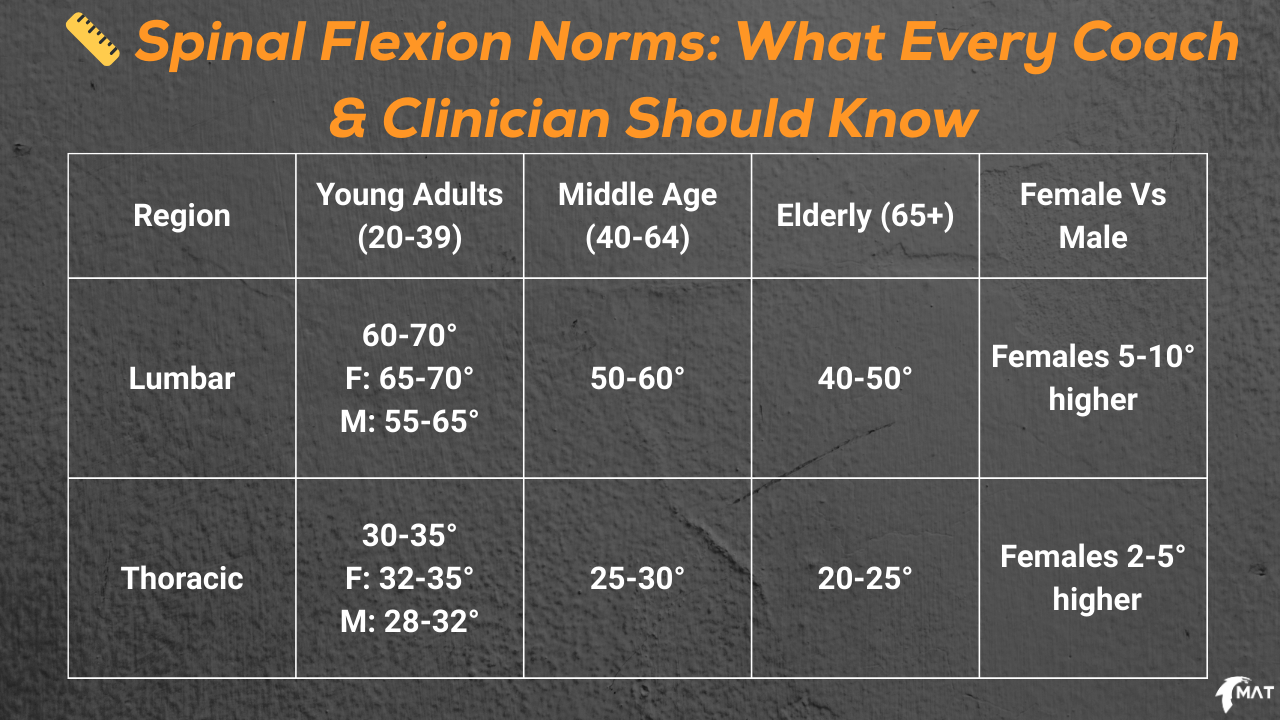
Most practitioners agree that spinal mobility is important. The harder question is how much mobility is actually normal — and how to interpret deviations without over- or under-reacting.
Normative spinal flexion data provides essential context, allowing mobility findings to be compared against expe...
The Shoulder External Rotation 0° Test measures how far the shoulder rotates outward with the arm by the side and the elbow flexed. It can be assessed actively or passively using a goniometer, inclinometer or smartphone ROM tool. The result helps track shoulder rotation, compare sides and add contex...
The Shoulder Internal Rotation 0° Test measures how far the shoulder rotates inward with the arm by the side and the elbow flexed. It can be assessed actively or passively using a goniometer, inclinometer or smartphone ROM tool. The result helps track shoulder rotation, compare sides and add context...


