
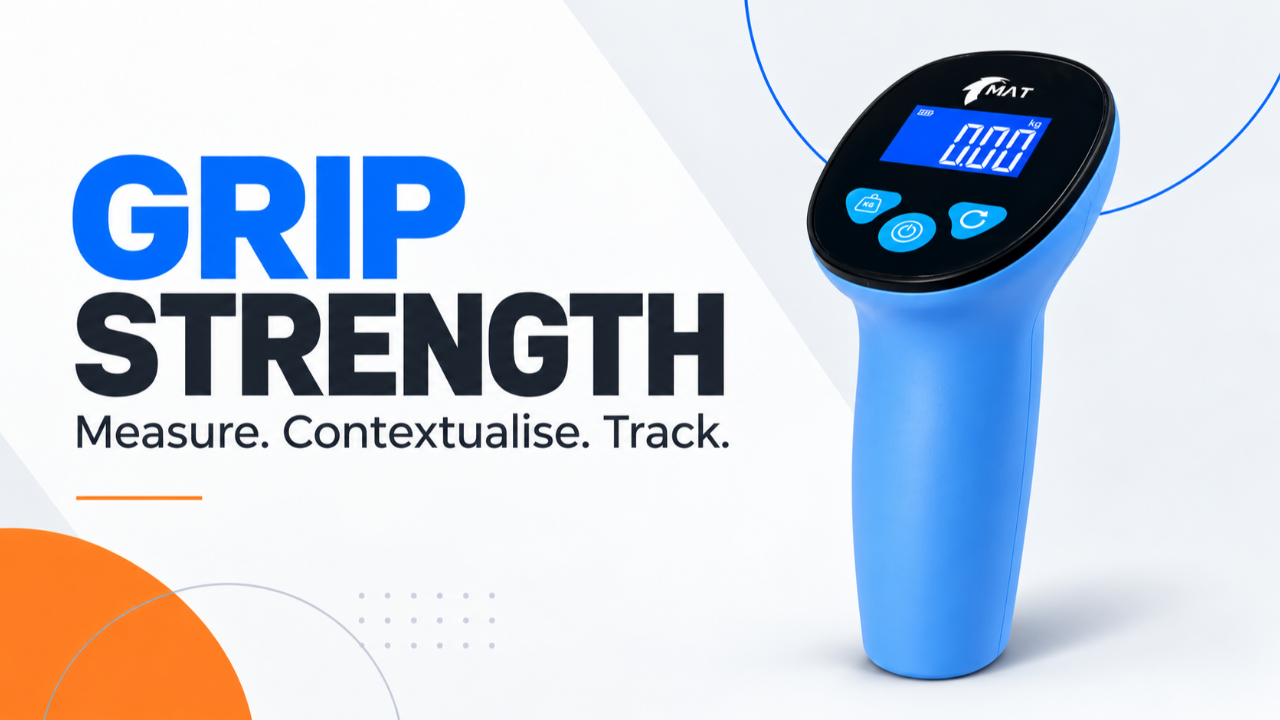
Grip strength is a simple, practical way to measure hand strength and build an objective picture of physical capacity. Comparing results with appropriate population reference values and tracking them over time makes the assessment more useful for everyday activity, work and performance.
Relative gr...
The Pull Test – Double Arm [Muscle Meter] measures how much force a client can produce during an isometric two-arm pulling task against a fixed resistance. It is commonly used to assess bilateral upper-body pulling force in a controlled setup. This can provide useful context for rowing, climbing, gr...
The Pull Test – Single Arm [Muscle Meter] measures how much force a client can produce during an isometric one-arm pulling task against a fixed resistance. It is commonly used to assess unilateral upper-limb pulling force in a controlled setup. This can provide useful context for rowing, climbing, g...
The Paper-Grip Test – 2–5 Toes [Muscle Meter] measures how much force is required to pull a card or paper strip from underneath the lesser toes while the client attempts to grip it. It is commonly used to assess toe-grip force through toes 2–5 in a practical foot-strength setup. This can provide use...
The Paper-Grip Test – 1st Toe [Muscle Meter] measures how much force is required to pull a card or paper strip from underneath the big toe while the client attempts to grip it. It is commonly used to assess hallux gripping force in a practical, foot-strength-focused setup. This can provide useful co...
The Wrist Ulnar Deviation [Muscle Meter] test measures how much force a client can produce when moving the wrist toward the little-finger side against resistance. It is commonly used to assess wrist ulnar deviation force output in a controlled isometric setup. This can provide useful context for gri...
The Wrist Radial Deviation [Muscle Meter] test measures how much force a client can produce when moving the wrist toward the thumb side against resistance. It is commonly used to assess wrist radial deviation force output in a controlled isometric setup. This can provide useful context for gripping,...
The Pronation [Muscle Meter] test measures how much force a client can produce when rotating the forearm so the palm turns downward against resistance. It is commonly used to assess forearm pronation force output in a controlled isometric setup. This can provide useful context for gripping, lifting,...
The Supination [Muscle Meter] test measures how much force a client can produce when rotating the forearm so the palm turns upward against resistance. It is commonly used to assess forearm supination force output in a controlled isometric setup. This can provide useful context for gripping, lifting,...
The Supination Resistance Test [Muscle Meter] measures the amount of external force required to initiate supination of the foot and ankle in a weight-bearing position. It is commonly used to provide context for foot posture, subtalar joint mechanics, lower-limb loading, footwear or orthotic reasonin...
The Shoulder Horizontal Abduction [Muscle Meter] test measures how much force a client can produce when moving the arm away from the midline in a horizontal plane against resistance. It is commonly used to assess isometric posterior shoulder and scapular retraction-related force in a controlled setu...
The Shoulder Horizontal Adduction [Muscle Meter] test measures how much force a client can produce when moving the arm across the body against resistance. It is commonly used to assess isometric horizontal adduction force in a controlled setup. This can provide useful context for pushing, pressing, ...


