
How to Use the Muscle Meter: Quick Start Guide 🎯
Whether you're testing strength for rehab, performance, or just flexing your data nerd muscles, the Muscle Meter makes objective measurement simple and fast.
🎥 Watch the video above where we walk you through:
-
How to turn the Muscle Meter on/off
...
The Isometric Standing Calf Raise Test measures how much force a client can produce when pressing through the forefoot in a standing, weight-bearing plantarflexion position. It is commonly used to assess calf force output in a controlled standing setup.
This test can provide useful context for walk...
The Isometric Double-Leg Squat Test measures how much force a client can produce when pushing against an immovable setup from a fixed squat position. It is commonly used to assess bilateral lower-limb force output in a controlled, repeatable position.
This test can provide useful context for squatt...
Single Leg Belt Squat Test: A Practical Guide for Assessing Unilateral Lower Limb Strength
The Single Leg Squat Test is a highly effective and accessible tool for measuring unilateral lower limb strength, particularly useful in identifying asymmetries between legs. This test offers a low-impact way...
The Mid-Thigh Pull Strength Test measures how much force a client can produce when pulling upward against an immovable bar, strap, handle or fixed setup from approximately mid-thigh height. It is commonly used to assess maximal isometric whole-body force production, especially in strength and condit...
The Isometric Front Squat Test measures how much force a client can produce when pushing against an immovable setup from a fixed front squat position. It is commonly used to assess lower-limb force output in a squat position that also requires upright trunk control and front-rack or front-loaded pos...
The Isometric Seated Calf Raise Test measures how much force a client can produce when pressing the forefoot downward against resistance while seated with the knee flexed. This position is commonly used to provide more context around knee-flexed plantarflexion strength and soleus-biased force capaci...
The isometric push-up test is an effective way to assess upper body strength in a static position.
When conducted with Muscle Meter and Tester platform the test allows you to measure peak force exerted during an isometric hold, providing objective data to guide training and monitor progress over t...

The Mid-Thigh Pull (MTP) test is a common assessment used to measure maximal isometric strength, particularly of the lower body. This test is used in athletic performance assessments, rehabilitation, and strength and conditioning. While specific normative data for the MTP varies depending on the pop...
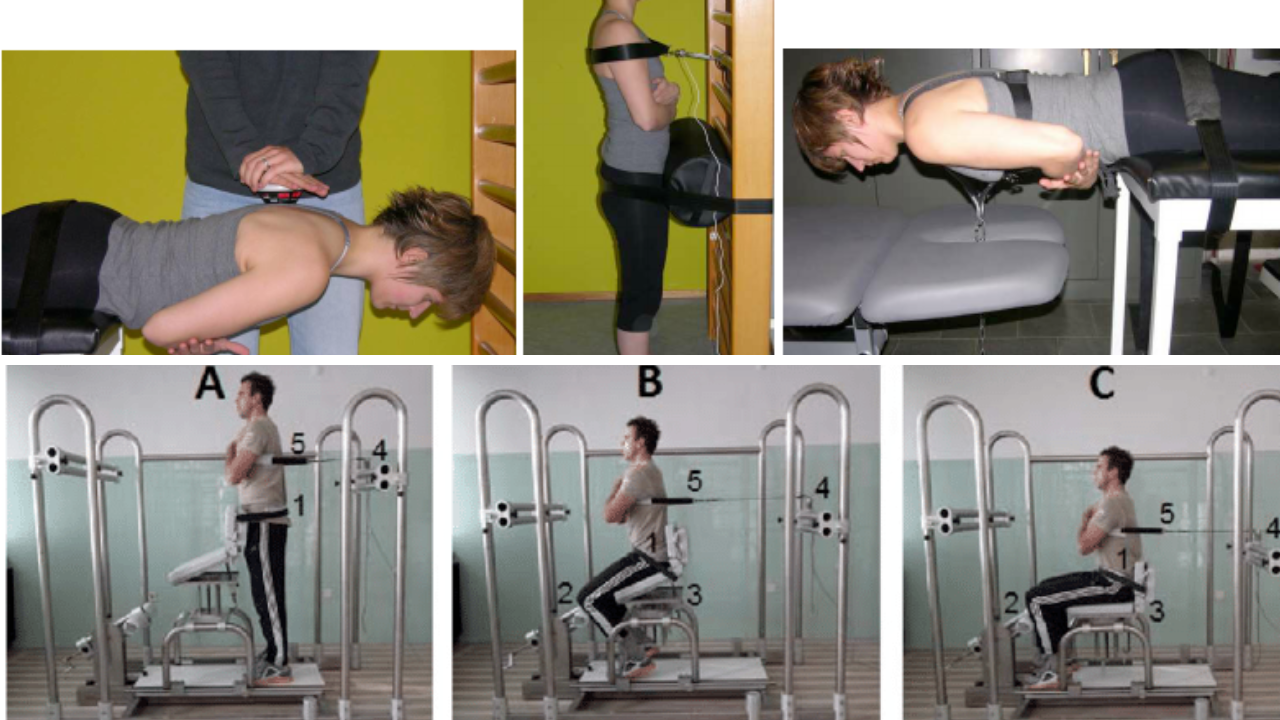
The Spinal Flexion Strength Test measures how much force a client can produce when flexing the trunk forward against a Muscle Meter, handheld dynamometer or fixed resistance setup.
This test can be performed using either:
-
The pusher cap, where the client pushes forward directly into the Muscle
...
Spine lateral flexion refers to the bending of the spine sideways, either to the left or right, primarily engaging the muscles along the side of the torso. Performing this movement helps enhance flexibility and strength in the muscles supporting the spine.
Here's how to perform spine lateral flexio...
The Spine Rotation test assesses how far a client can rotate the trunk or spine to the left and right. It may be performed in standing, sitting, side-lying or lumbar-locked positions using observation, tape measure, goniometer, inclinometer, smartphone inclinometer or digital movement tools. The res...


