
Spinal Flexion Normative Values: What’s Normal Across Age Groups
Feb 16, 2026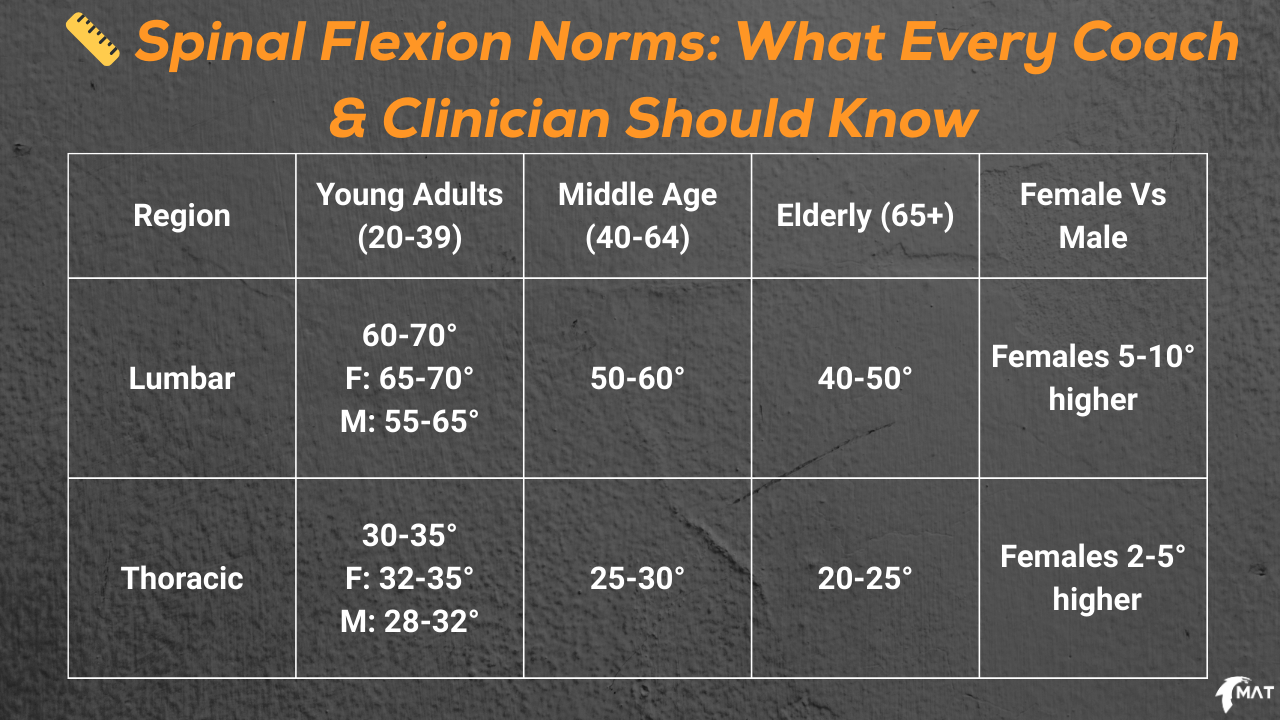
Most practitioners agree that spinal mobility is important. The harder question is how much mobility is actually normal — and how to interpret deviations without over- or under-reacting.
Normative spinal flexion data provides essential context, allowing mobility findings to be compared against expected values for age and sex. Without this reference point, it becomes difficult to determine whether reduced motion reflects pathology, normal ageing, or simply individual variation.
Why This Data Is Useful
Screening and Assessment
Normative values allow spinal mobility to be assessed relative to peer-matched expectations rather than subjective judgement.
For example, a 30-year-old male presenting with ~40° of lumbar flexion sits well below expected norms and may warrant further investigation for restriction, pain-related inhibition, or altered motor control.
Using reference data helps identify potential red flags early and supports more consistent clinical reasoning.
Tracking Progress and Outcomes
Spinal flexion norms are particularly valuable when monitoring change over time.
Post-intervention or post-injury, reassessment allows practitioners to determine whether mobility is:
-
Returning toward expected ranges
-
Plateauing below normative values
-
Improving meaningfully beyond measurement variability
This is relevant across populations — from athletes aiming to restore performance capacity to individuals rebuilding function after injury or persistent painDifferentiating Healthy vs Non-Healthy Presentations
Clear differences exist between healthy populations and those with spinal pathology.
-
Healthy lumbar flexion (young adults): ~60–70°
-
Chronic low back pain: commonly ~35–45°
These contrasts help practitioners:
-
Objectively justify interventions
-
Avoid relying on pain reports alone
-
Monitor whether changes reflect functional improvement rather than short-term symptom fluctuation
Age and Sex Considerations
Spinal mobility is not static across the lifespan.
-
Flexion typically declines by ~0.3–0.6° per year after age 30
-
Females generally demonstrate slightly greater range of motion than males
-
Expecting identical values across age groups risks over-pathologising normal age-related change
Normative data allows expectations to be adjusted appropriately, improving interpretation and communication.
Normative Spinal Flexion Ranges
Lumbar Spine Flexion
-
20–39 years: 60–70° (♀ > ♂)
-
40–64 years: 50–60°
-
65+ years: 40–50°
Thoracic Spine Flexion
-
20–39 years: 30–35°
-
40–64 years: 25–30°
-
65+ years: 20–25°
Non-Healthy Populations
Spinal flexion is commonly reduced in clinical populations:
-
Chronic low back pain: ↓ ~15–35%
-
Post-spinal fusion: ↓ up to ~60%
Understanding the expected magnitude of change helps set realistic goals and prevents inappropriate comparison to healthy norms.
Practical Takeaway
Knowing spinal flexion norms helps practitioners to:
-
Set realistic and defensible goals
-
Detect abnormal restriction or excessive motion
-
Tailor mobility and stability strategies to individual needs
Spinal mobility data becomes most powerful when interpreted with context — age, sex, health status, and longitudinal change — rather than as a single isolated number.
Key References
Knežević et al. (2019)
Muyor et al. (2020)
Nair et al. (2021)
Seay et al. (2022)
Wang et al. (2022).
Download Our Measurz App For FREE And Perform, Record and Track 800+ Tests With Your Clients Today.
Want To Improve Your Assessment?
Not Sure If The MAT Data-Driven Approach Is Right For You?
Get a taste of our MAT Course and data-driven approach using the MAT with a FREE module from our online MAT Course.
We hate SPAM. We will never sell your information, for any reason.


