
Anterior Hop Test Normative Data & Performance Interpretation
Feb 05, 2026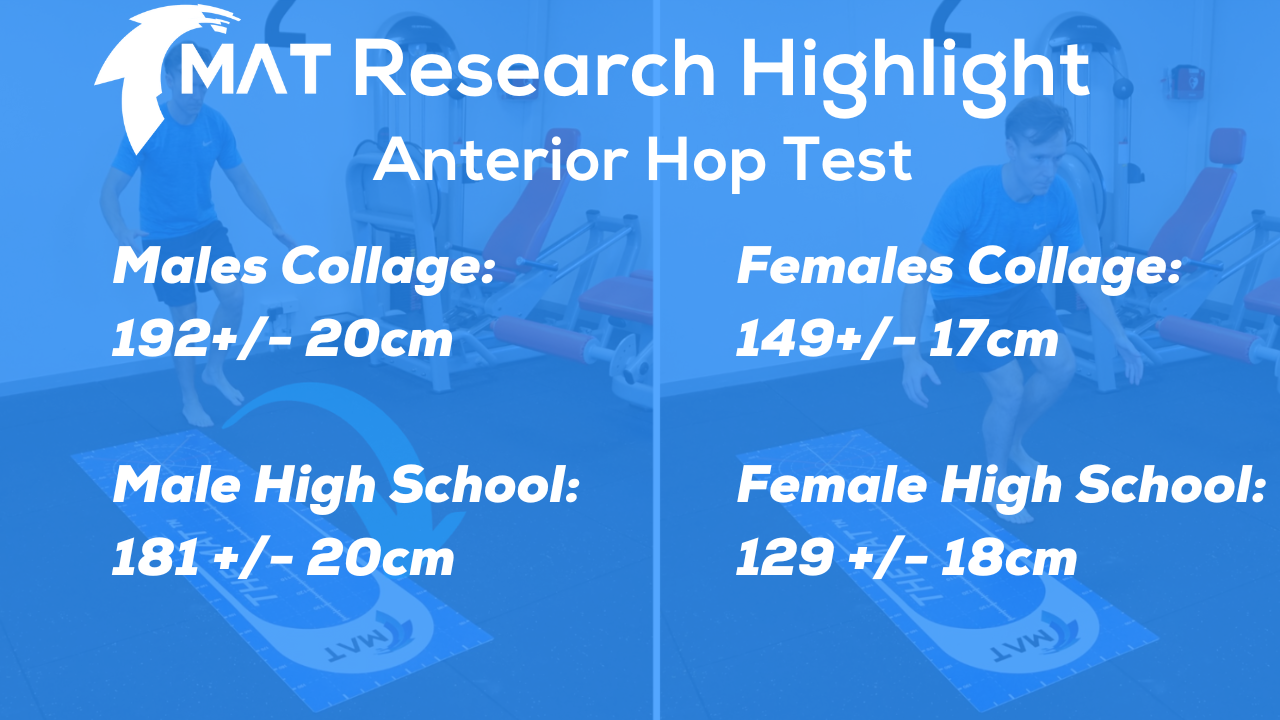
The Anterior Hop Test is widely used to assess single-leg horizontal power, control, and confidence. While distance alone is useful, its real value comes from comparing performance against normative reference data rather than relying on symmetry or change alone.
Recent work by Weber et al. (2024) provides age- and sex-specific normative values that help place hop performance into meaningful context.
Anterior Hop Test Normative Values (Mean ± SD)
-
Males (College): 192 ± 20 cm
-
Males (High School): 181 ± 20 cm
-
Females (College): 149 ± 17 cm
-
Females (High School): 129 ± 18 cm
These benchmarks allow practitioners to move beyond “better than last time” and towards expected capacity.
Why This Matters
Athletes
For athletes, hop distance is often interpreted through limb symmetry alone. However, symmetry does not guarantee adequate performance capacity.
Normative data helps answer:
-
Is this athlete symmetrical but still underperforming compared to peers?
-
Does hop distance align with sport demands and level of competition?
-
Is the athlete returning to play with sufficient horizontal power, not just confidence?
Using norms alongside symmetry improves decision-making around:
-
Return-to-performance benchmarks
-
Performance profiling
-
Objective goal setting
General Population
In non-athletic populations, hop performance provides insight into:
-
Lower-limb power capacity
-
Confidence with single-leg loading
-
Functional performance relative to age and sex
Normative values help frame results in a way clients understand:
-
“Where do I sit compared to others like me?”
-
“Is this a strength, or an area to improve?”
This context improves buy-in, motivation, and long-term engagement with assessment-driven programs.
Real-World Case Example
A 20-year-old male recreational athlete completes an Anterior Hop Test following a structured training block.
-
Right leg: 185 cm
-
Left leg: 183 cm
-
Asymmetry: <2%
At first glance, this appears to be an excellent result — minimal asymmetry and consistent performance.
However, when compared to college-aged male norms (192 ± 20 cm), overall hop distance sits slightly below the group mean.
Key takeaway:
Symmetry alone suggests readiness, but normative data highlights a potential opportunity to further develop horizontal power capacity.
This insight allows practitioners to:
-
Set clearer performance targets
-
Justify continued focus on power development
-
Communicate progress without relying on subjective judgement
Using Normative Data the Right Way
Normative values are not pass/fail rules. They are context tools.
When combined with:
-
Side-to-side comparison
-
Longitudinal tracking
-
Task-specific demands
They strengthen interpretation, guide decisions, and improve how assessment results are communicated to clients.
Used well, the Anterior Hop Test becomes more than a task — it becomes a benchmark for capacity, progress, and informed decision-making.
Download Our Measurz App For FREE And Perform, Record and Track 800+ Tests With Your Clients Today.
Want To Improve Your Assessment?
Not Sure If The MAT Data-Driven Approach Is Right For You?
Get a taste of our MAT Course and data-driven approach using the MAT with a FREE module from our online MAT Course.
We hate SPAM. We will never sell your information, for any reason.


