
What Is Normal Hip Extension — and Why Should You Test It?
May 04, 2026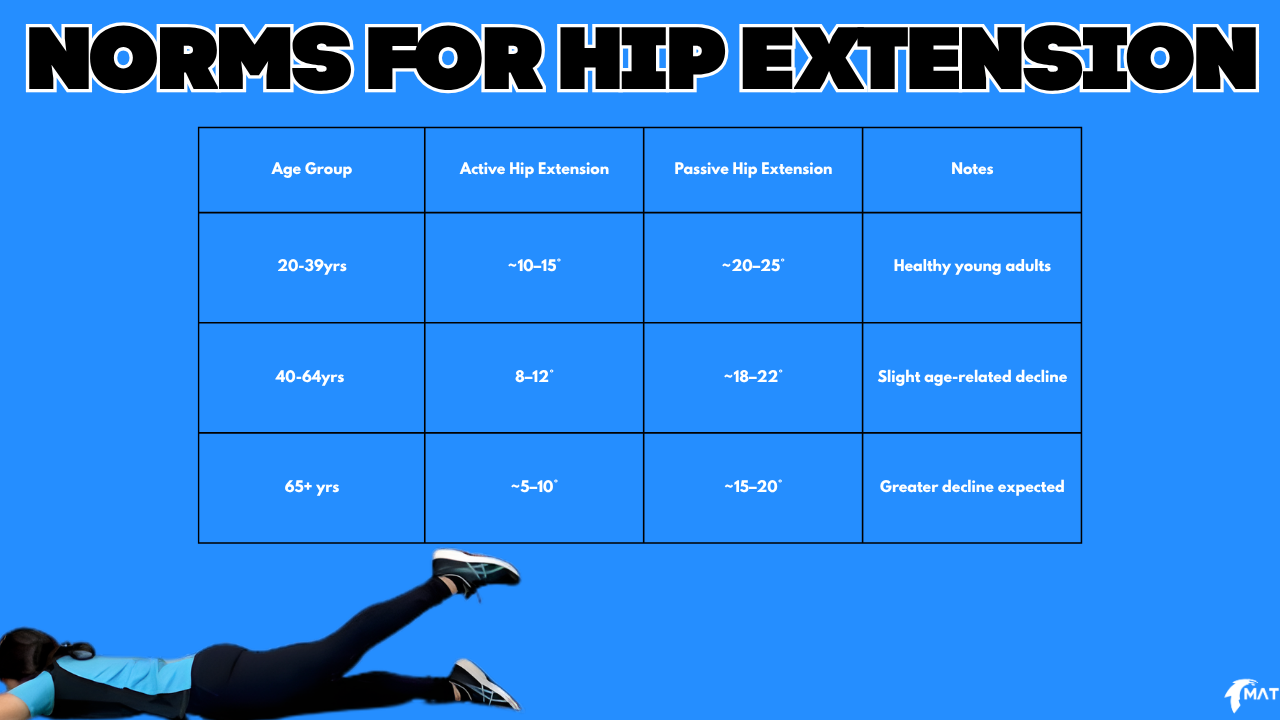
Why Hip Extension Matters
Hip extension is one of those movements that often gets overlooked — until it becomes a problem.
It plays an important role in walking, running, squatting, deadlifting, lunging and changing direction. It also influences how the pelvis and lumbar spine move during everyday and athletic tasks.
When hip extension is limited, the body may try to find movement elsewhere. That can mean more movement through the lumbar spine, altered pelvic position, or changes in stride, squat depth or hip loading strategy.
This does not mean every restriction causes pain or injury. But it does mean hip extension is worth measuring — especially when a client reports tightness, reduced stride length, difficulty getting into hip extension positions, or repeated compensation during training.
What Is Normal Hip Extension?
Normative values vary depending on the testing method, population, age and whether the movement is measured actively or passively.
As a general guide:
- Active hip extension: commonly around 10–15°
- Passive hip extension: often reported around 20–25°
- Age-related changes: hip range of motion may gradually decline with age
Large reference-value studies show that joint range of motion can vary by age and sex, and that average ROM values often decrease with advancing age. This makes it important to compare results carefully rather than relying on one “perfect” number.
Research on older adults has also suggested that available hip extension range of motion may influence how much ROM is required or available during gait.
Why You Should Test Hip Extension
Subjective tightness does not always tell the full story.
A client might say their hip flexors feel tight, but without measuring hip extension, it is hard to know whether they actually have a mobility restriction, a strength-control issue, or a movement strategy problem.
Objective hip extension testing can help professionals:
- Establish a baseline
- Compare left and right sides
- Monitor change over time
- Identify mobility limitations
- Guide exercise selection
- Track progress during training or intervention blocks
It also gives you something concrete to revisit. Instead of asking, “Does it feel looser?”, you can ask, “Has the measurement changed?”
How to Test Hip Extension
A simple and repeatable approach is to use an inclinometer to measure hip extension in a consistent position.
For best results:
Use the same testing position each time
Measure both sides
Record whether the test is active or passive
Note pelvic or lumbar compensation
Retest under similar conditions
Track results over time
The key is consistency. A perfect number is less useful than a repeatable measurement you can trust.
How MAT Tools Can Help
The Inclinometer can be used to measure hip extension more objectively than visual estimation alone.
The Measurz app can help record results, compare sessions and monitor change over time.
Together, they make it easier to move from “this looks restricted” to “this is the measured range, and here is how it is changing.”
That is especially useful when working with:
Athletes needing hip extension for sprinting, kicking or field-based movement
Strength clients performing squats, deadlifts, lunges or hip-dominant lifts
Older adults where hip mobility may influence gait and functional movement
General population clients who report recurring tightness or movement restriction
Key Takeaway
Hip extension may not be the flashiest movement to test, but it matters.
It influences gait, lifting, running, pelvic control and how the lower limb absorbs and produces force.
By measuring hip extension with an inclinometer and tracking results in Measurz, professionals can better identify limitations, monitor progress and make more informed exercise decisions.
Because mobility that is measurable becomes mobility you can actually track.
References
Anderson, D. E., & Madigan, M. L. (2014). Healthy older adults have insufficient hip range of motion and plantar flexor strength to walk like healthy young adults. Journal of Biomechanics, 47(5), 1104–1109. https://doi.org/10.1016/j.jbiomech.2013.12.024
Roach, S. M., San Juan, J. G., Suprak, D. N., Lyda, M., Bies, A. J., & Boydston, C. R. (2015). Passive hip range of motion is reduced in active subjects with chronic low back pain compared to controls. International Journal of Sports Physical Therapy, 10(1), 13–20.
Soucie, J. M., Wang, C., Forsyth, A., Funk, S., Denny, M., Roach, K. E., & Boone, D. (2011). Range of motion measurements: Reference values and a database for comparison studies. Haemophilia, 17(3), 500–507. https://doi.org/10.1111/j.1365-2516.2010.02399.x
Download Our Measurz App For FREE And Perform, Record and Track 800+ Tests With Your Clients Today.
Want To Improve Your Assessment?
Not Sure If The MAT Data-Driven Approach Is Right For You?
Get a taste of our MAT Course and data-driven approach using the MAT with a FREE module from our online MAT Course.
We hate SPAM. We will never sell your information, for any reason.


