
Grip Strength as a Percentage of Body Weight: Why It’s a Key Health Indicator
Feb 09, 2026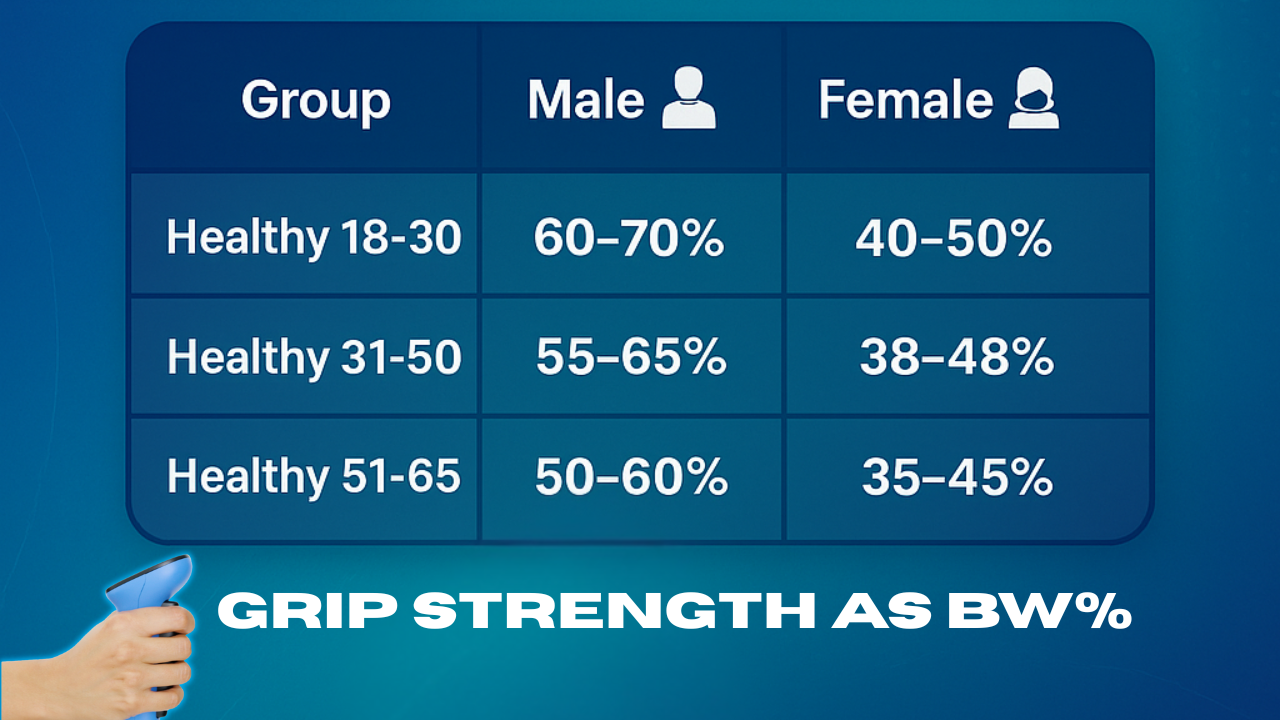
Grip strength is often thought of as a simple measure of hand or forearm strength. In reality, it is one of the most robust and widely studied indicators of overall health, functional capacity, and long-term outcomes across the lifespan.
Rather than relying on absolute grip strength alone, recent research has emphasised relative grip strength, expressed as a percentage of body weight (%BW). This approach provides a more meaningful interpretation by accounting for body size and composition.
Large population datasets have shown that grip strength relative to body weight is a stronger predictor of health outcomes than raw grip values or body mass index (BMI) alone.
Normative Grip Strength Values (% Body Weight)
Based on high-quality population data, healthy grip strength relative to body weight typically falls within the following ranges:
Ages 18–30
-
Males: 60–70% BW
-
Females: 40–50% BW
Ages 31–50
-
Males: 55–65% BW
-
Females: 38–48% BW
Ages 51–65
-
Males: 50–60% BW
-
Females: 35–45% BW
These values provide practical benchmarks to contextualise grip performance across age and sex, rather than interpreting strength in isolation.
Why This Matters
Health & Independence
Grip strength is consistently associated with:
-
Functional independence
-
Mobility capacity
-
Risk of falls and disability
Lower relative grip strength has been linked to earlier decline in daily function, particularly as individuals age. Importantly, this decline can occur even when body weight remains stable, highlighting the value of ratio-based interpretation.
Mortality Risk
Large cohort studies, including national health surveys and longitudinal population datasets, demonstrate that relative grip strength is a stronger predictor of all-cause mortality than BMI.
Individuals with low grip strength relative to body weight show significantly higher mortality risk, independent of age, sex, or body mass. This positions grip strength not just as a performance metric, but as a meaningful health marker.
Clinical Red Flags
Grip strength ratios consistently below ~30% of body weight are commonly associated with:
-
Frailty
-
Increased risk of chronic disease
-
Neurological, metabolic, or musculoskeletal conditions
In these cases, grip strength becomes an early screening tool — flagging reduced physiological reserve before more obvious symptoms emerge.
Real-World Case Example
A 45-year-old male, body weight 85 kg, records a peak grip strength of 42 kg.
-
Relative grip strength: ~49% BW
While the absolute value may appear “reasonable,” comparison to normative ranges for males aged 31–50 (55–65% BW) shows that performance sits below expected capacity.
Key insight:
Without relative benchmarking, this deficit may be overlooked. Using % body weight highlights a potential gap in overall strength capacity that may be relevant for health, work demands, or long-term resilience.
This context supports clearer goal-setting, progress tracking, and communication — grounded in objective data rather than subjective interpretation.
Using Grip Strength Data Effectively
Grip strength should not be viewed as a standalone number. Its value increases when interpreted alongside:
-
Body weight and composition
-
Age- and sex-matched norms
-
Longitudinal trends over time
When used this way, grip strength becomes a simple, fast, and powerful metric for assessing capacity, monitoring change, and supporting informed decision-making.
Key References
-
Peterson MD et al., Journal of Cachexia, Sarcopenia and Muscle (2019)
-
Dodds RM et al., BMJ (2014)
-
Kim M et al., Journal of Epidemiology & Community Health (2019)
Download Our Measurz App For FREE And Perform, Record and Track 800+ Tests With Your Clients Today.
Want To Improve Your Assessment?
Not Sure If The MAT Data-Driven Approach Is Right For You?
Get a taste of our MAT Course and data-driven approach using the MAT with a FREE module from our online MAT Course.
We hate SPAM. We will never sell your information, for any reason.


