
The Metrics That Actually Explain Performance: Impulse, RTD, Torque , TTP & Fatigue Index
Jan 01, 2026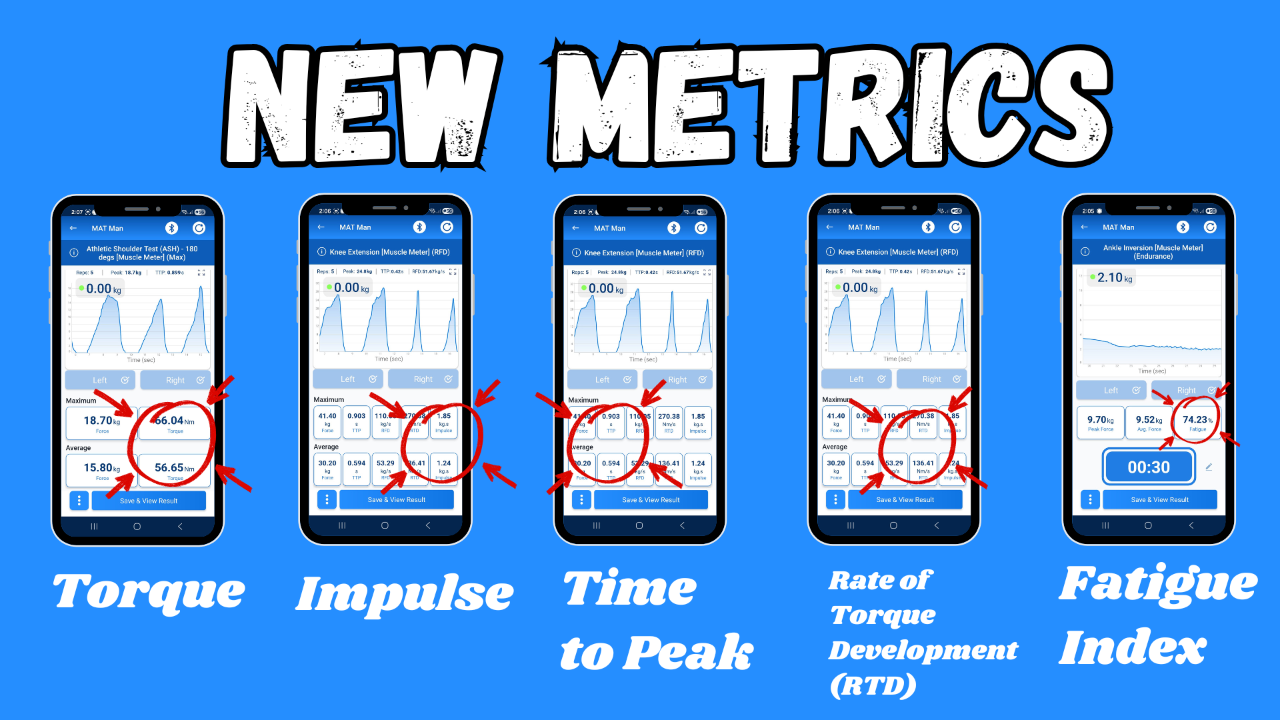
Peak force tells you how much strength exists.
But real-world performance, control, and robustness depend on how quickly force appears, how long it lasts, and how well it is controlled under fatigue.
That’s where advanced force–time metrics — Impulse, Rate of Torque Development (RTD), Torque, Time to Peak, and Fatigue Index — provide insight that raw strength numbers alone cannot.
Using Testing Mode in Measurz, these metrics are captured objectively and consistently, transforming complex force behaviour into clear, defensible assessment data.
Why These Metrics Matter (Beyond Peak Strength)
In sport and daily life:
-
Force must be produced quickly
-
Force must be maintained or repeated
-
Force must be absorbed and controlled
-
Key events occur before maximal force is reached
Two individuals may show identical peak strength yet differ dramatically in performance and load tolerance.
These metrics explain why.
🔋 Impulse — How Force Is Used Over Time
What Is Impulse?
Impulse is the total force applied over time.
In simple terms:
- It’s not just how hard someone pushes — it’s how long they can sustain that force.
Impulse links strength to movement by describing how effectively force creates momentum, absorbs load, and controls deceleration.
Why Impulse Is Important
Impulse reveals qualities peak force cannot:
-
Sustained force creates more usable momentum than brief peaks
-
Highlights braking, stiffness, and load-absorption strategies
-
Explains jumping, sprinting, landing, and change-of-direction performance
Impulse shows force behaviour, not just force magnitude.
⚡ Rate of Torque Development (RTD) — How Fast Strength Turns On
What Is RTD?
RTD measures how quickly torque is produced around a joint.
Where peak torque reflects capacity, RTD reflects:
-
Reactivity
-
Neuromuscular readiness
-
Early-phase force availability
Most performance-critical events occur within 0–200 ms, well before peak torque is achieved.
Why RTD Is Important
RTD helps identify:
-
Delayed force production masked by high peak strength
-
Inefficient neuromuscular activation
-
Reduced ability to stabilise or decelerate quickly
-
Readiness for fast, reactive tasks
RTD connects strength to speed of movement.
⏱ Time to Peak — How Long It Takes to Reach Maximal Output
What Is Time to Peak?
Time to Peak measures how long it takes to reach maximum force or torque during a contraction.
Unlike RTD (which looks at the rate of force rise), Time to Peak reflects the overall speed of force expression from onset to maximum.
Why Time to Peak Is Important
A longer Time to Peak may indicate:
-
Slower neuromuscular recruitment
-
Reduced intent or confidence
-
Fatigue-related delay
-
Protective or cautious force strategies
Two people may reach the same peak torque — but the one who reaches it faster is better equipped for rapid, real-world demands.
Time to Peak adds essential temporal context to strength data.
🔧 Torque — Strength Where Movement Actually Happens
What Is Torque?
Torque is rotational force around a joint.
It reflects how effectively force is applied at the joint axis, making it more anatomically and functionally relevant than force alone.
Why Torque Is Important
Torque allows professionals to:
-
Assess true joint-specific strength
-
Compare individuals with different limb lengths
-
Detect asymmetries hidden in compound tasks
-
Track meaningful mechanical changes over time
Torque turns “strength” into mechanically relevant information.
🔋 Fatigue Index — Whether Strength Holds Up
What Is Fatigue Index?
Fatigue Index quantifies how much force declines across repeated efforts.
In simple terms:
-
Peak force = capacity
-
Fatigue Index = repeatability and robustness
Why Fatigue Index Is Important
Fatigue Index reveals:
-
Early performance drop-off
-
Reduced load tolerance
-
Poor endurance strategies
-
Increased reliance on passive structures under fatigue
It distinguishes someone who is strong once from someone who is consistently strong.
Real-Life Examples by Subpopulation
🏃 Athletes
-
Impulse: sprint acceleration, jumping height, braking capacity
-
RTD: cutting, landing, rapid stabilisation
-
Time to Peak: readiness for explosive actions
-
Torque: joint-specific performance demands
-
Fatigue Index: late-game resilience and injury risk
Performance failures often stem from timing and durability, not max strength.
🚶 General Population
-
Impulse: stair descent, carrying loads
-
RTD: balance recovery after a trip
-
Time to Peak: confidence and speed in daily movements
-
Torque: task-specific joint capacity
-
Fatigue Index: tolerance to repeated daily tasks
These metrics explain why tasks feel difficult despite “adequate strength”.
🧓 Older Adults
-
Impulse: safe force absorption
-
RTD: rapid corrective responses (fall prevention)
-
Time to Peak: delayed reactions increasing risk
-
Torque: maintaining functional joint capacity
-
Fatigue Index: preserving control as fatigue sets in
Speed and endurance of force often matter more than peak output alone.
🧠 Chronic Pain / Persistent Symptoms
-
Impulse: cautious force application
-
RTD: delayed neuromuscular response
-
Time to Peak: protective slowing strategies
-
Torque: separating capacity from sensitivity
-
Fatigue Index: early decline despite normal peak values
Objective metrics help distinguish capacity limitations from protective behaviour.
Common Assessment Mistakes These Metrics Solve
-
Focusing only on peak force
-
Ignoring how fast force appears
-
Missing fatigue-related breakdown
-
Overestimating readiness based on max values
-
Failing to assess force behaviour under time pressure
How Measurz Brings These Metrics Together
Testing Mode in Measurz allows professionals to:
-
Visualise force and torque curves live
-
Quantify impulse, RTD, time to peak, torque, and fatigue index automatically
-
Compare limbs and sessions consistently
-
Track changes in performance behaviour over time
This turns complex force-time data into clear assessment insight.
Strength Isn’t Just About How Much — It’s About How Fast, How Long, and How Well
Impulse, RTD, Time to Peak, Torque, and Fatigue Index explain:
-
How force is generated
-
How quickly it becomes usable
-
How long it can be sustained
-
How effectively it is controlled
Measurz makes these invisible qualities measurable, supporting smarter assessments and more confident decisions.
Because strength only matters if it shows up — and holds up — when it counts.
Download Our Measurz App For FREE And Perform, Record and Track 800+ Tests With Your Clients Today.
Want To Improve Your Assessment?
Not Sure If The MAT Data-Driven Approach Is Right For You?
Get a taste of our MAT Course and data-driven approach using the MAT with a FREE module from our online MAT Course.
We hate SPAM. We will never sell your information, for any reason.


